

The blasphemous scholar declared, "I revere you, my teacher." Yet Anaxa's mentor knew well: "You love Truth more." This scene pays homage to Aristotle: "Plato is dear to me, but dearer still is Truth." At the Citizens' Assembly, Anaxa witnessed the Death Twins reunite across two lifetimes, laughing maniacally as he cried: "I have deciphered the truth of this world—"
The narrative repeatedly emphasizes "truth," but does this truly represent what Anaxa pursued? In this article, we return to the character's essence, exploring Anaxa's design through the four stages of alchemy. Let us delve into it together.

1. HSR Anaxa's "Nigredo Stage" - Design Elements
In alchemy, there exists a concept of the four stages of the Great Work. The alchemical process is divided by color and sequence into black, white, yellow, and red. The first stage, black, is Nigredo. At this stage, the alchemist must decompose the material through corruption and decay to obtain the primal substance. If we regard Anaxa as the product of this transmutation and deconstruct him through reverse engineering, we discover that his character design incorporates numerous profound elements.
Anaxa served as a professional instructor for the "Nousporists" at the Grove of Epiphany, teaching debate to youths like Hyacine and Phainon, enabling even Phainon to win ten consecutive debate championships, while also guiding their involvement in political life. Such individuals were collectively known in ancient Greece as Sophists—masters of rhetoric and dialectic.
Simultaneously, the theory of Nous and the name Anaxagoras point to another ancient Greek philosopher—Anaxagoras. He proposed the "seed theory" and introduced natural philosophy to Athens, shattering the traditional mythological worldview. In the game's card collection, Anaxa's card appears to be the only one currently in reverse position. Yet tracing its origin, the card's archetype should correspond to the upright "Hanged Man" in the Tarot deck.
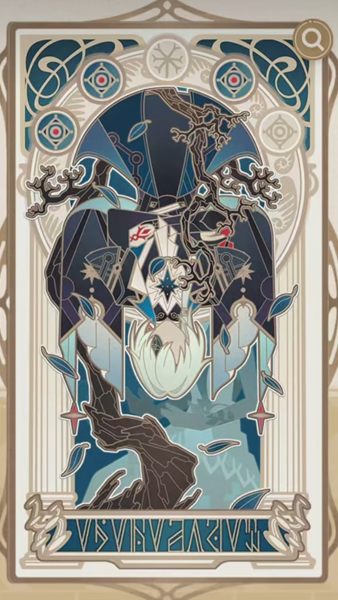
In our eyes, what seems a 'normal' world may appear upside-down to Anaxa. What we perceive as plunging him into dire straits—be it the resplendent Dromas, the Grand Performer, the blasphemer, or even the loss of physical parts like an eye or a heart—never became his shackles. Though inverted and deprived of an eye, he saw the world with unparalleled clarity.
Going further, Anaxa even shares connections with the two archetypes of the Hanged Man tarot card. Like Odin, who hung upside down and sacrificed an eye for wisdom. And more pertinently, like the Greek Titan Prometheus, who stole fire for humanity and was punished by being bound and tormented. Interestingly, in alchemy, the four roots of the world are Wind, Water, Earth, and Fire. Before Castorice alchemically resurrected Thanatos, she mentioned Sky Aquila, Ocean Phagousa, Earth Georios—and the last was Fire Kephale.
Within Amphoreus's worldview, Kephale has always been portrayed through themes of burden and suffering. Yet, aligned with the four roots, Kephale symbolizes the dry and scorching essence of Fire. Anaxa ascended Dawncloud to forge Kephale's soul. He is, in truth, the Prometheus who stole sacred fire for Amphoreus. All these elements may seem chaotic, but just as in alchemy's Nigredo process—after corruption and decomposition—we must still distill, sublimate, and purify them.
2. Anaxa's "Albedo Stage" - Dimensions of Character
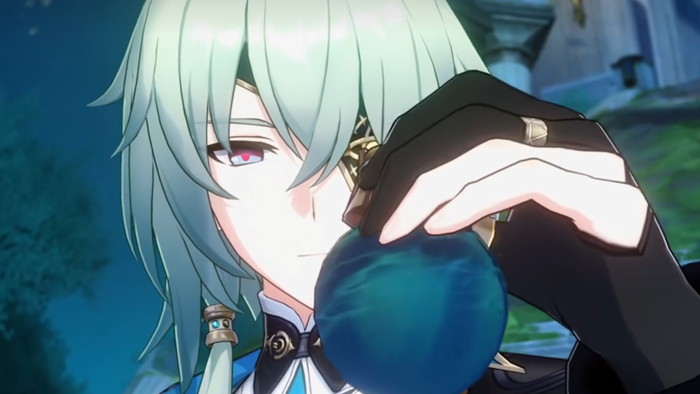
Albedo, also known as the White Chalk or White Purity. At this stage, we purify Anaxa's various character settings in three steps based on the aforementioned materials. The most prominent dimension is the duality of rationality and madness.
As the head of the "Nousporists" at the Grove of Epiphany, he inherits the theories of "The First Scholar," perceiving and transforming the world through rational skepticism and transmitting knowledge and truth. Yet he spearheads the challenge to the mythological worldview, viewing Titans merely as "unconquered forces," using alchemy to tamper with all that should not be tampered with—employing his own soul and body.

Another dimension is the duality of blasphemy and reverence, consistent with Greek mythology. Anaxa abandoned faith in his youth, questioning the legitimacy of the Flame-Chase Journey. At the Citizens' Assembly near the story's climax, he even revealed that Titans were merely heroes of the previous cycle's Chrysos Heir Dolium, shattering the people's mythological worldview. Ironically, the most blasphemous individual was forced to host the soul of the Rational Titan. More ironically, upon realizing that gods were once human, Anaxa's attitude toward divine power and authority reversed completely; he eagerly sought to harness this power to create a perfect world.
Beyond this, coldness and warmth form another crucial contradiction. Anaxa's words often carry a tone of detachment. He mocks Phainon with sarcasm, claiming his "glib tongue is most memorable." Yet Anaxa and Aglaea, both demigods, ultimately reached a rare consensus in their evaluation of Phainon. Anaxa never hesitates to praise outstanding students, sincerely thanking Castorice for helping him unveil the truth; he also takes genuine pride in Phainon and places high hopes in him. The warmth Anaxa embodies is as terrifyingly rational as his approach to all things in the world.
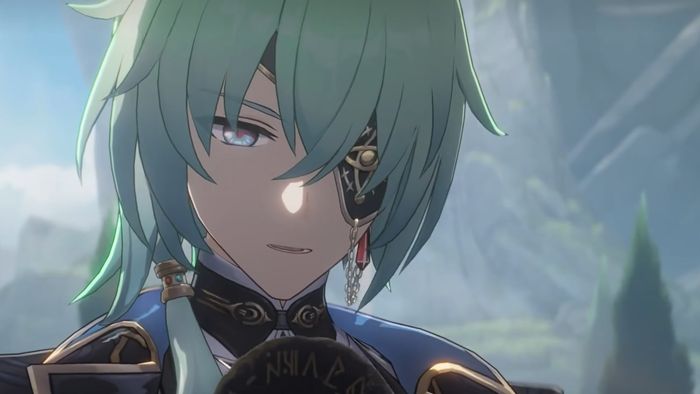
Through the Albedo stage, we have distilled the contradictory dimensions of Anaxa's character. These dimensions contribute to his enduring complexity: warm yet cold, rational yet mad, and reverent yet blasphemous. What harmonizes these traits without making them seem fragmented or inconsistent?
3. Anaxa's "Citrinitas Stage" - Core Contradiction
After experiencing the storyline, we realize that every character's defining moment stems from choices made under pressure. Just as in the alchemical stage of Citrinitas, purified materials undergo further combination through the addition of new elements (pressure). Here, we decipher the key to reconciling Anaxa's contradictions through his final behavioral paradox.
Anaxa's most critical contradiction lies between rationality and life, manifesting as the conflict between survival and self-destruction. When the Black Tide invaded the Grove of Epiphany, Anaxa split his soul to forge a barrier against the invasion. Ultimately overwhelmed, this most irreverent man pinned his hopes for survival on the Titan's fire seed.
Yet seeds of self-destruction have always existed within him. He traded an eye merely to see his sister once and exchanged his heart—knowing it meant no return—to unravel the nature of humans and Titans. At the Citizens' Assembly, he single-handedly dragged the Council of Elders into the abyss. The deepest irony: if "unraveling truth" is his paramount goal, why did he face death without regret while questions remained unanswered? Instead, he cried out about "seeds of doubt" and stepped first into the next cycle.
The opposition between survival and self-destruction seems irreconcilable—unless all of it serves life itself. As a scholar noted, "Our study of rationality lacks rational depth." From Cerces choosing to descend as a Giant Wise Tree to the Black Tide forcing exodus, Nousporists discovered that those relying solely on rationality perish quickly, while those heeding both reason and life's call endure adversity. "Thus, transcending humanity through cold alchemical calculus is doomed to fail."

True transformation requires understanding rationality's dual nature: it is both a guide for thought and a rhythm of life. Reexamining Anaxa's survival and self-destruction through this lens reveals that life's essence lies not in bodily longevity nor in attaining answers, but in the acts of "questioning" and "seeking knowledge" themselves. To thrust skepticism's branches into the sacred tree of wisdom and sow seeds of doubt in human hearts—this is Anaxa's ultimate understanding of rationality, forged through suffering and inverted martyrdom, surpassing so-called "Truth." Like his card suggests, behind the so-called Truth stands a lush green Giant Wise Tree.
4. Anaxa's "Rubedo Stage" - The Measure of All Things
Early alchemy focused on the material realm, pursuing gold and immortality. As human understanding of the world grew more objective, alchemy evolved toward philosophical and spiritual exploration. From this period onward, the meaning of the "Philosopher's Stone" transcended turning stone to gold and extending life indefinitely.
Under Cerces's witness, Anaxa casually tossed Castorice a dark red stone—a "Philosopher's Stone" forged from the flesh and blood of sages, crystallizing their collective wisdom. This marked the final stage of Anaxa's transmutation: Rubedo. Rubedo represents the sublimation from matter to spirit, from flesh to soul. Anaxa stated in the storyline, "Alchemy is the art of transformation, refinement, and sublimation—the same applies to the pursuit of truth. However unbelievable, the world's truth has been refined from impurities."

Like the duality of Greek mythological figures, Anaxa embodied the very essence of what he and Cerces called the "stone"—the sublimation from impurity to purity. He practiced this with his own body: eyes, heart, flesh, and soul were all refined away to unravel the world's truth. Yet upon touching truth, he swiftly regressed into decay and bitterness—like gold dissolving in aqua regia, like annotated pages rotting away—returning to a state of ignorant suffering, yet finding joy within it.
This is the essence of rationality: "Rationality" does not exist because of truth; it is the necessary "corruption," "distillation," "quenching," and "sublimation" on the path to truth. Even when leaving puzzles unsolved, even when losing so-called truth, one must retain "doubt."
That concludes all the content about Anaxa. I wonder if you now understand his actions after reading this. Of course, Amphoreus's grand narrative has not yet concluded, and Anaxa's life will not fade away! Also, don't miss out on more articles and our site's merchandise.