

Why does the collaboration between Honkai: Star Rail and Fate bring both joy and concern? Why is it accused of appealing to the otaku crowd? And what lesser-known cold knowledge about this Fate collaboration might you not know? Welcome to this beginner's guide to the Honkai: Star Rail × Fate [Unlimited Blade Works] collaboration.
However, if you want to better understand the collaboration content, the best method is still to experience the original work. Considering that the Fate series itself is a classic IP over twenty years old, a single article cannot fully showcase its entirety to the Trailblazers. Therefore, today we will only introduce several key concepts to facilitate a quick start for the Trailblazers.
1. Beginning of the Fate Series
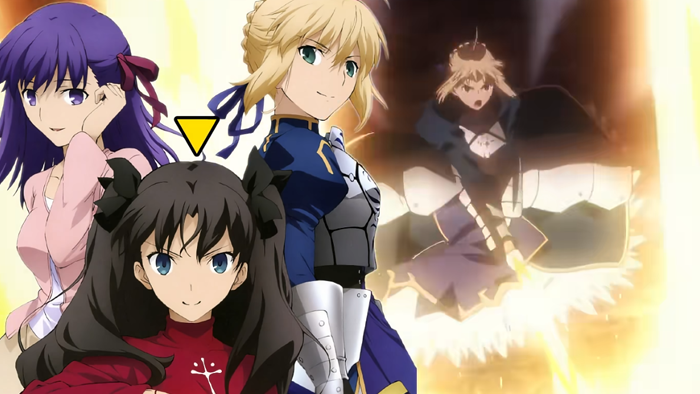
The Fate/Stay Night UBW featured in this collaboration originates from the 2004 game 'Fate/Stay Night." It depicts the story of the protagonist, Shirou Emiya, who, through a twist of fate, becomes involved in the Fifth Holy Grail War.
The original work comprises three main storylines: "Fate," "Unlimited Blade Works," and "Heaven's Feel." Based on the different heroines, they are also known as the Saber route, the Rin route, and the Sakura route. All three storylines have been adapted into animations. If you wish to watch the anime version, it is highly recommended to start with the two-season TV version of UBW produced by Ufotable to experience the authentic Holy Grail War.
2. Fate: Holy Grail War
The content of the Holy Grail War is that Heroic Spirits from different eras and countries respond to the summons, arrive, form contracts with Masters in the present world as Servants, and fight each other to seize the Holy Grail that can grant wishes, until only one Servant remains who can obtain the Holy Grail.
However, in fact, the Holy Grail War has a serious problem of "false advertising." If other competitions have the prize prepared before the start, and the winner only needs to claim it and leave, then the special aspect of the Holy Grail War is that the losers are also part of the final prize. The souls of defeated Servants will be contained by the Holy Grail and will only be released after the final winner is determined. The souls then return to the Throne of Heroes outside the world. The power from this process is used to pierce the world, thereby achieving the true purpose of holding the Holy Grail War—to create a passage that can lead outside the world.
As for the "almighty wish-granting device," it has been a deception from the very beginning. The victor can only utilize the massive magical energy resources that flow out during the piercing process. It's like finding a magic lamp, but the lamp's method of granting your wish is simply giving you money. Can this be considered almighty? Clearly not. Can it grant wishes? For most wishes, probably yes.

Unfortunately, the Holy Grail today cannot even grant wishes normally. As early as the Third Holy Grail War, the Holy Grail in Fuyuki City was contaminated by the specially summoned Avenger, the Servant bearing the name "Angra Mainyu." Since then, the Holy Grail has lost its function as a harmless wish-granting device and has become a materialized calamity.
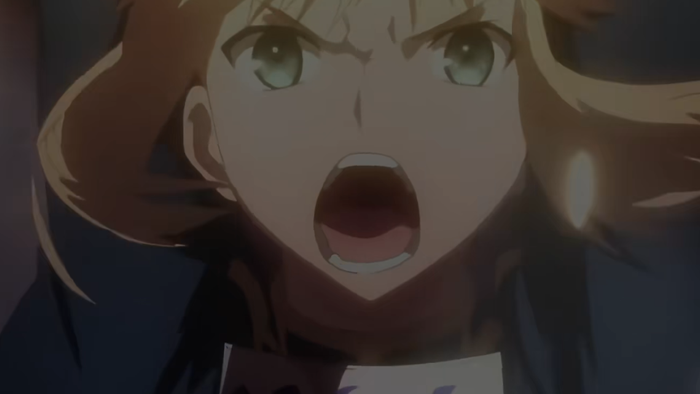
At the end of the UBW route, Saber activated her Noble Phantasm and destroyed the Holy Grail. From the preview content, we can learn that this Holy Grail also has a concept of contamination level. And the ending replicates the classic conclusion from UBW.
3. Fate Servants
As an essential component of the Holy Grail War, the Servant system has its own rules. To summon a Servant suitable for themselves, a Master usually prepares a Holy Relic associated with a specific Heroic Spirit to increase the probability of it responding to the summons.
For example, Shirou relied on the scabbard within his body to summon Saber; Rin used her family's heirloom gemstone necklace, which had once saved Shirou's life, to summon Archer. After finding a suitable Heroic Spirit, the Holy Grail retrieves the Heroic Spirit's high-purity soul from the Throne of Heroes, then assigns a Class based on its characteristics, generating a clone of the Heroic Spirit in the present world - the Servant. Simultaneously, the Master who successfully completes the summoning becomes the anchor allowing the Servant to remain in the present world and receives three Command Spells that can forcibly command the Servant.
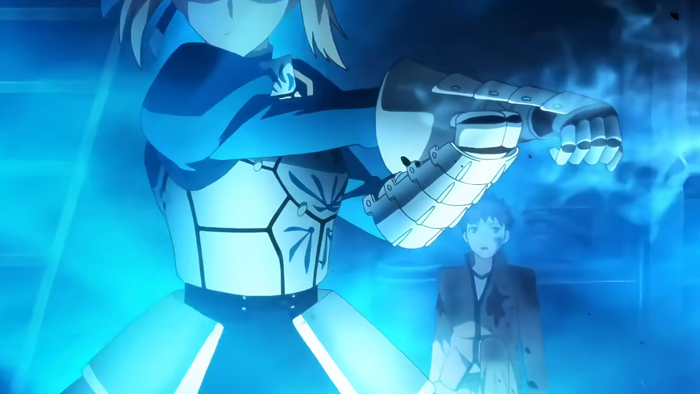
To avoid exposing their identities, Masters typically address their Servants by their Class names, and the vast majority of participating Servants, much like the real people behind VTubers, will try every means to conceal their true names. The reason is simple: revealing one's true name often means exposing their weaknesses. The higher a Servant's fame, the easier it is for opponents to find targeted countermeasures. For example, using the classic "Achilles' Heel" as a "dark joke" that Trailblazers can better understand: if you knew your opponent had summoned Mydei, what strategy would you adopt in subsequent battles? The answer is obvious—aim for his tenth thoracic vertebra.
So, the introduction to Fate's content ends here. To help all Trailblazers understand this collaboration better, the following section will briefly introduce the three highly popular characters featured in this collaboration, aiming to provide a better and more immersive crossover experience for everyone.
4. Honkai: Star Rail - Fate Collaboration Characters
4.1 Saber
Saber Altria Pendragon, the monarch of Britain, the legendary King Arthur. Perhaps many Trailblazers have this question: why is King Arthur written as a girl? In fact, in the original setting, Arthur Pendragon was indeed male, and his Master was female. However, considering the overall trend of the anime market at the time, the decision was ultimately made to swap the genders of the two, thus giving us the Saber of today, who integrates numerous elements such as young girl, monarch, strength, and food lover into one character.
Although she plays the role of a lofty national ruler in legend, in daily life, Saber also inadvertently reveals her more girlish side, liking small animals and loving delicious food.
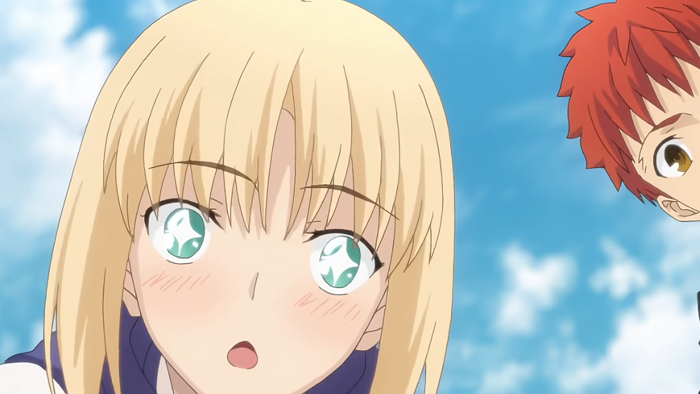
It is worth mentioning that Saber's love for delicious food transcends ordinary boundaries. While nominally for replenishing magical energy, the deeper reason lies in the fact that she had little access to tasty food during her lifetime. The original work even features a gag ending where a character is instantly killed for not feeding Saber, highlighting the depth of her obsession.
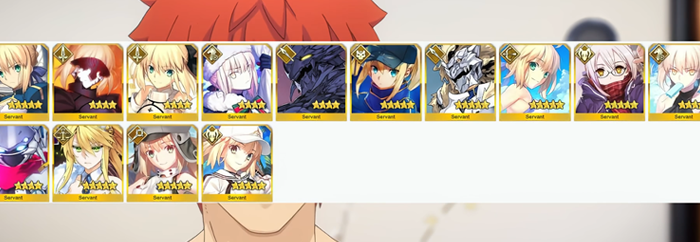
Furthermore, as a highly popular character in the Fate series and the face of Fate/Grand Order (FGO), her design has influenced numerous subsequent characters. Within FGO, there are not only various Altria variants but also a specific "Saber-face" trait.
It is important to note that the sword on Saber's exclusive Light Cone and the sword in her illustration are not the same. The sword on the Light Cone is the Sword in the Stone (Caliburn), used for selecting the monarch, widely known in the legend of "whoever pulls this sword from the stone shall become king." The sword held by Saber in the illustration, however, is the Holy Sword (Excalibur) later bestowed by the Lady of the Lake.
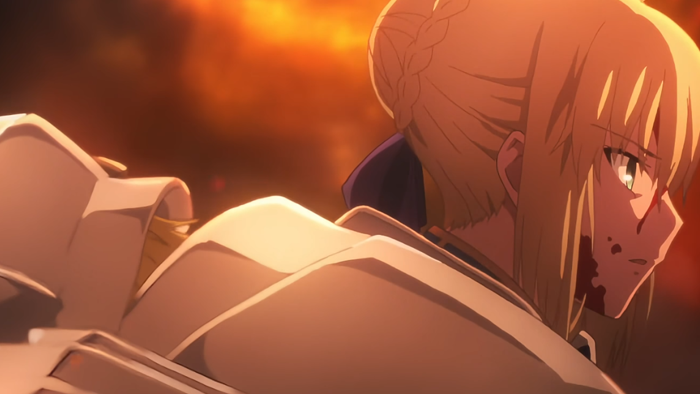
Compared to other Heroic Spirits who ascended to the Throne of Heroes after death, Saber is a rather special existence. She responded to the Holy Grail's summons at the brink of death to become a Servant, attempting to use the Holy Grail to reselect a king and alter the fate of Britain's destruction.
Each time her Spirit Origin dissipates, her ritual returns to the battlefield of Camlann, awaiting the next opportunity. But this effort is ultimately futile; the era's end was inevitable, with Britain being its final remnant. Saber has already done all she could.
4.2 Archer
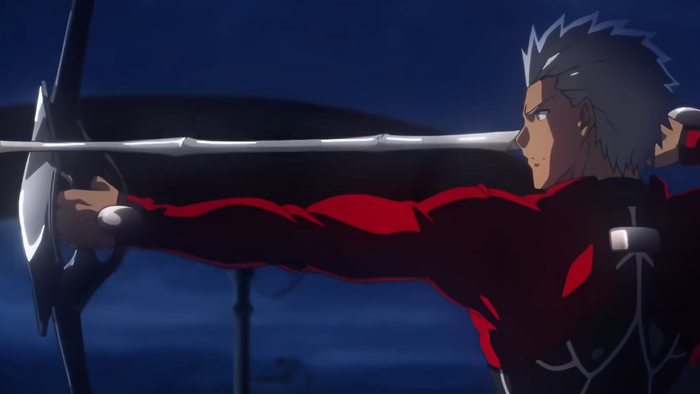
Archer, Emiya, is a hero from the future. His ability is similar to the Herrscher of Reason; any item he analyzes can be replicated by consuming magical energy. Unlike other Servants whose Noble Phantasms are sublimated from their lifetime deeds, the numerous weapons he uses are temporarily copied through 'Projection,' making them unqualified counterfeits. Precisely because they are counterfeits, he can detonate the weapons without hesitation to cause considerable damage.
As a modern Heroic Spirit who is as capable on the battlefield as he is in the kitchen, Archer is not only unique in combat but can also be called a high-quality male in daily life. Unlike ancient Heroic Spirits, who even need the Holy Grail to impart basic common sense, Archer possesses rich housekeeping experience. Whether it's cleaning, cooking, or making tea, he can accomplish it all excellently, earning him titles related to housekeeping.
What's even rarer is that this time, Archer was summoned to the era of his own past life, even to the city where he once lived—it's like a home ground within a home ground. However, when Rin asked him for more information, he brushed it off with the excuse that 'the summoning was incomplete, and memories are missing.' He could even say without changing his expression, "I am the strongest Servant."
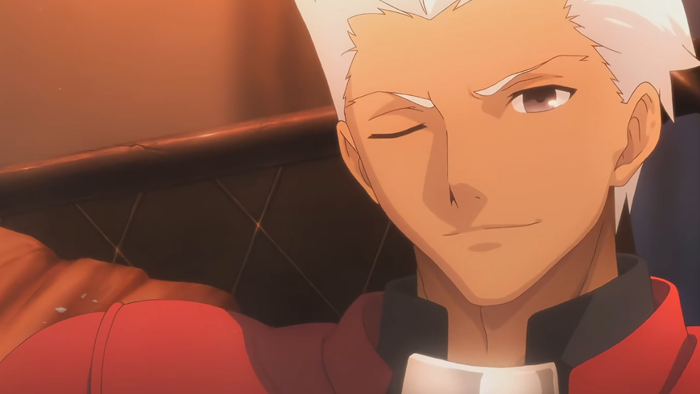
It must be particularly emphasized that Archer is the future version of Shirou Emiya, yet in the original work, no matter which storyline Shirou Emiya follows, he will not become the present Archer. The only certainty is that her experiences are similar to, yet different from, the original storylines. Officials have mentioned that Archer's story path should resemble the Fate route, but it is not any of the currently known Fate route endings.
As a modern human, he originally should not have become a Heroic Spirit. However, to save others, he made a contract with the Counter Force of the Primate, the price being his transformation into a Heroic Spirit, appearing as a "Guardian" on various battlefields, ensuring the continuation of the group by eliminating specific individuals. In the endless slaughter, his ideal of wanting to protect others was constantly challenged, leading him to doubt himself. Even after being summoned in the Fifth Holy Grail War, he once harbored the idea of killing his past self to erase his own existence. Yet, no matter which storyline, he ultimately chooses to fight to protect others, even at the cost of his own life.
4.3 Lancer
Lancer Cú Chulainn, original name Sétanta. A warrior in Celtic mythology, the strongest fighter of Ulster. In his youth, he killed the hound of the blacksmith Culann, and as compensation, he vowed to guard Culann himself in the hound's place. Similar to Saber, Lancer also has a 'prototype" that differs from his current setting. The design for this collaboration draws some inspiration from Cú Chulainn (Prototype).
As a pure warrior, Lancer presents two completely different faces in work and life. At work, he is callous, killing civilians to silence them without batting an eye; in daily life, however, he is bold and unconstrained in nature, very much like a reliable, caring big brother.
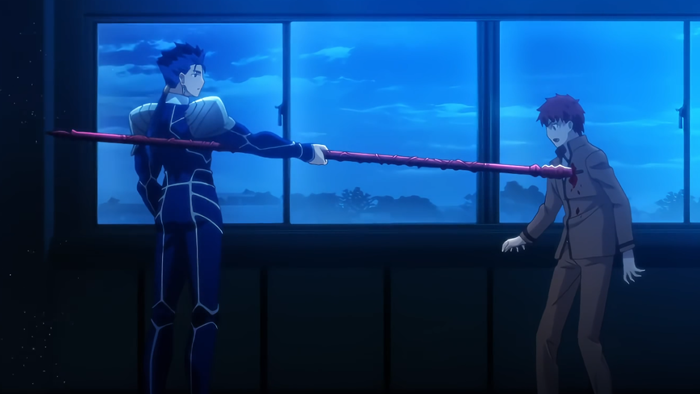
Compared to Saber wielding an invisible holy sword and Archer capable of projecting various weapons, Lancer's Noble Phantasm appears much more modest—a single crimson-red long spear. However, one must never underestimate this spear, as it possesses two completely different forms. One has the ability to reverse causality, akin to how the "Hunt's' Reverse-Time Strike" allows the result—"the enemy's heart being pierced"—to exist before the action—"throwing the spear"—occurs.
The other form allows the spear to disperse itself for concentrated attacks, claimed by Lancer himself to even "surpass its prototype—Odin's 'Gungnir'". Furthermore, the "Caladbolg II" (Pseudo-Spiral Sword), which Archer uses as an arrow when unleashing his battle technique, shares a deep connection with Lancer. Its prototype, the "Caladbolg" (Spiral Sword), was originally wielded by his friend and foster father. A vow made during his lifetime imposes a restriction on Lancer: if the wielder of Caladbolg has a connection to Ulster, Lancer is destined to be defeated by this sword once again.
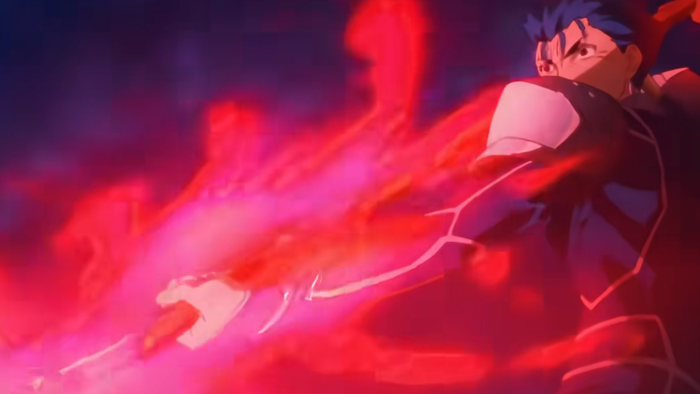
A Noble Phantasm capable of reversing causality, coupled with rich combat experience—Lancer certainly had the potential to achieve brilliant results. Ironically, his luck was truly abysmal. An attack meant to pierce the heart was dodged by Saber with her "Luck B"; he did not fall on the battlefield, but was forced to commit suicide by his second Master using a Command Spell. All signs prove that his "Luck E" is not without reason. Even the official works use Luck E to jest about Lancer; in "Carnival Phantasm", he practically cannot escape his fate of death in every episode. However, from another perspective, this time Lancer's Master is Boothill, who often says "love you," so at least there's no need to worry about being betrayed by the Master.
The above content is an exploration of some little-known facts about this Honkai: Star Rail × Fate/Stay Night [Unlimited Blade Works] collaboration. In truth, it merely scratches the surface of Fate's vast worldview.
However, we believe this collaboration will surely make Trailblazers develop a fondness for Fate, while Honkai: Star Rail itself has also experienced unprecedented popularity! Do not forget to continue following our articles. See you next time!